
Sourcing Lithium Ion Batteries: Certifications and Specs Checklist for 2026
Sourcing Lithium Ion Batteries: Certifications and Specs Checklist for 2026
When procuring lithium ion batteries for high‑tech applications such as drones, robots, or medical devices, the difference between a reliable supplier and a risky one often comes down to certifications and technical specifications. In 2026, the global lithium‑ion battery market exceeds USD 164.8 billion (GMI Research, 2024), and China alone exported over 3.9 billion units in 2024 (General Administration of Customs). Against this scale, industrial buyers need a clear checklist to verify compliance, performance, and logistics readiness.
Shenzhen Topway New Energy Co., Ltd. (trading as HCC) is a Chinese manufacturer that focuses on custom lithium‑ion battery packs for robotics, drones, exoskeletons, and medical equipment. With a 10 000 m² factory, 200 employees, and an independent R&D team of 15, HCC supplies 40 % of its output to overseas markets including the EU, USA, and Asia. Below is a structured guide to the certifications and parameters every buyer should evaluate in 2026.
Problem Definition: Why Certification & Specs Matter More in 2026
Lithium‑ion batteries are classified as dangerous goods. International shipping regulations—such as IATA DGR 59th (2018) and the UN Manual of Tests and Criteria Subsection 38.3—impose strict packaging, labelling, and state‑of‑charge limits. Starting January 2026, the IATA SoC limit for lithium batteries packed with equipment (PI 966) is 30 %. Buyers who ignore these rules face shipment delays, fines, or safety incidents. At the same time, application‑specific parameters—discharge current, temperature range, cycle life—determine whether a battery can actually power an agricultural drone or a delivery robot without failure.
Industry Background
The IEC 62133‑2 standard remains the primary international safety benchmark for portable lithium cells and packs. The UN38.3 test report is mandatory for air transport, and customs authorities in the EU and USA often require CE and UL documentation. HCC holds:
- UN38.3 Certificate (No. CMC240627016) for model HCC18650‑10S5P‑L01, valid through 2099.
- CE Certification (DL‑20211210007C) covering rechargeable HV Li‑ion storage batteries, compliant with EN IEC 61000 series.
- MSDS Certification (HCC‑MSDS‑2615) for cylindrical batteries, valid until 2031.
- KC Certification (CKC‑2020‑002088) for the Korean market, based on KC 62133.
- Identification Report for Air Transport (PEKGZ20180103150GJX0001) for Li‑ion cells shipped at ≤30 % SOC.
- Sea Transport Report (CMC251017116H03) for large packs, complying with IMDG Code 2025.
- 1.2 m Drop Test (NO.1119110302) for Li‑ion cell IFR18650.
These certificates cover more than a dozen product lines, from 14500 cells to 48 V energy storage packs.
Detailed Solution: HCC’s Certified Product Portfolio
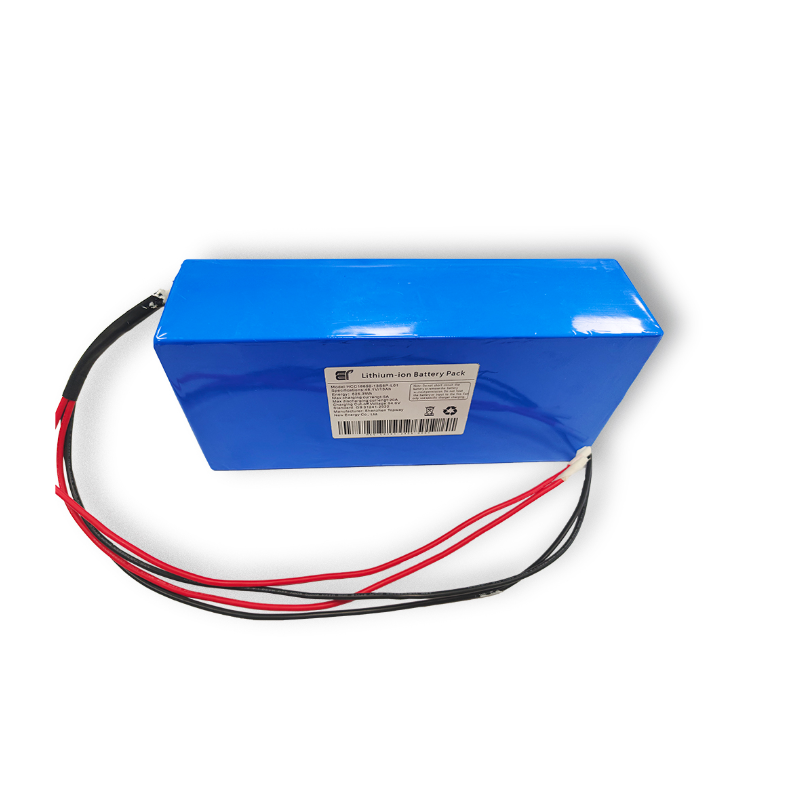
HCC offers a broad range of lithium‑ion batteries, each with documented certifications and parameters. The table below compares four representative models:
| Model / Name | Type | Voltage | Capacity | Max Discharge | Temperature | Material |
|---|---|---|---|---|---|---|
| 18650 3.6 V 3000 mAh | Rechargeable Li‑ion | 3.6 V | 3000 mAh | 3 A | ‑20 °C ~ 60 °C | NCM |
| 21700‑TW01 | Li‑ion | 3.7 V (nominal) | — | 1C continuous | — | NCM |
| 14500 3.7 V 500 mAh | 14500 battery | 3.7 V | 500 mAh | 1C | ‑20 °C ~ + 60 °C | NCM |
| 48V13Ah LiFePO₄ | Rechargeable Li‑ion | 48 V | 13 Ah | 20 A | ‑20 °C ~ 60 °C | LiFePO₄ |
All listed batteries are covered by HCC’s UN38.3, MSDS, and, where applicable, CE or KC certificates. For custom packs (e.g., 25.6 V 30 Ah delivery robot battery or 12.8 V 28 Ah medical battery), HCC adds project‑specific documentation as part of its OEM/ODM service.
Step‑by‑Step Certification & Parameter Check
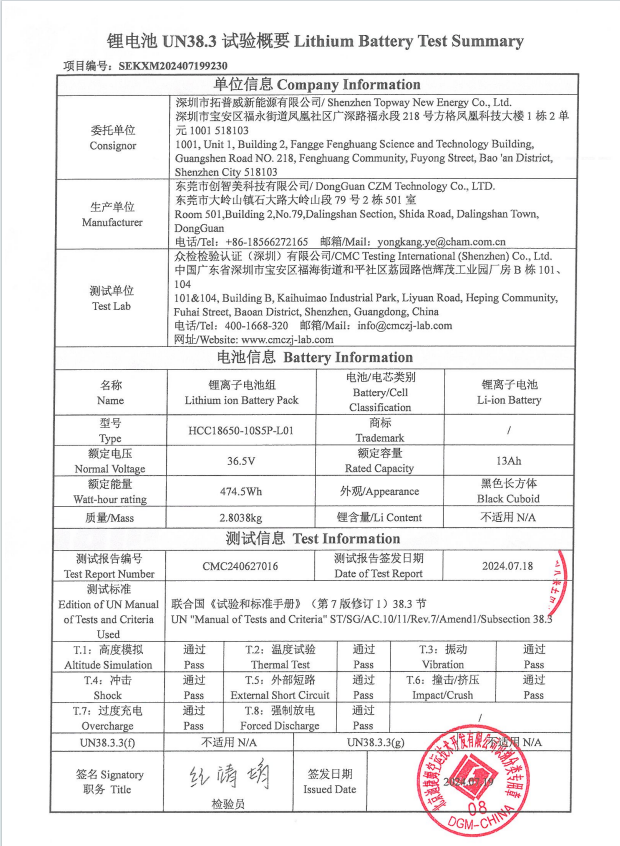
- Request the UN38.3 test report for your specific model. Verify the test summary includes T1–T8 tests and the cell/pack was tested by an accredited lab (e.g., CMC Testing).
- Check the SOC limits for air shipments. For 2026, ensure the report confirms a ≤30 % SOC for equipment‑packed batteries (PI 966).
- Confirm country‑specific marks: CE for EU, KC for Korea, UL/CSA for North America if required. HCC’s certificates explicitly list the applicable models and valid until dates.
- Review the MSDS (material safety data sheet) for emergency response and transport classification.
- Validate the electrical parameters against your device’s needs: nominal voltage (e.g., 3.6 V, 22.2 V), capacity (Ah), max continuous discharge current, and operating temperature range.
- Inspect the drop test certificate if the battery will be handled in logistics; a 1.2 m drop certification proves basic structural integrity.
- Ask for the production cycle and quality control. HCC operates with a monthly capacity of 10 000 units for custom packs, a lead time of 20–35 days, and an MOQ as low as 5 pieces for prototypes.
Use Cases: Certified Batteries in Action

Agricultural Drone Battery (25.2 V 20 Ah, model 25.2V 20AH)
This NCM pack delivers 20 A continuous discharge and works in ‑10 °C ~ 60 °C environments. A US agricultural drone manufacturer ordered 2 000 pcs and reported high‑rate stability during spraying operations, supported by HCC’s UN38.3 and CE documentation.
Delivery Robot Battery (25.6 V 30 Ah, model 25.6V 30AH)
A Spanish delivery robot manufacturer procured 2 000 units for indoor restaurants. The LFP chemistry provides a stable 5 A discharge, with an embedded BMS that manages temperature and overcurrent. HCC supplied MSDS and transport reports for sea freight.
Exoskeleton Robot Battery (custom 5 Ah pack)
A US exoskeleton company ordered 10 000 custom packs. The battery supports high‑rate bursts (3 ~ 5 C) for 20 ~ 50 kg loads and is covered by UN38.3 and drop‑test certificates. Cycle life exceeds 800 cycles, confirmed by HCC’s test data.
Frequently Asked Questions
What certifications are mandatory for international air shipment of lithium ion batteries in 2026?
How can I verify that a battery supplier's UN38.3 certificate is valid and covers my specific model?
What is the typical lead time and minimum order quantity for custom battery packs?
Which parameters are most critical for a drone battery?
Can I get a sample or quote for a specific battery specification?
Conclusion
For industrial buyers evaluating lithium ion battery suppliers in 2026, a systematic verification of certifications and technical specifications is the only way to avoid costly compliance failures and performance gaps. HCC combines a certified portfolio (UN38.3, CE, MSDS, KC) with flexible OEM/ODM capabilities, short lead times, and low MOQs—making it a practical choice for R&D teams and volume procurement alike. Visit HCC’s website or contact the sales team to discuss your next project.
Have Questions or Need More Details?
Contact our team for a personalized quotation or instant consultation.
Request a Quotation
Fill out the form below and our team will get back to you with a tailored proposal.
WhatsApp Direct Chat
Prefer to chat in real-time? Message us on WhatsApp for instant assistance & quick answers.
- Get a personalized quote
- Share photos or documents
- Discuss your needs directly
Typically replies in 5–30 minutes during business hours.