
Racing Drone Battery Technical Parameters Decoded: C-Rating, Internal Resistance, and Voltage Sag
Three numbers decide how a racing drone battery behaves in the air: continuous C-rating, internal resistance, and voltage sag under load. C-rating states how much current a pack claims to deliver, internal resistance explains how much of that current becomes heat instead of thrust, and voltage sag is the visible result on the flight controller. This guide explains what each parameter actually governs, how to read a datasheet without trusting the sticker, and how to verify the claims before committing to a production order.
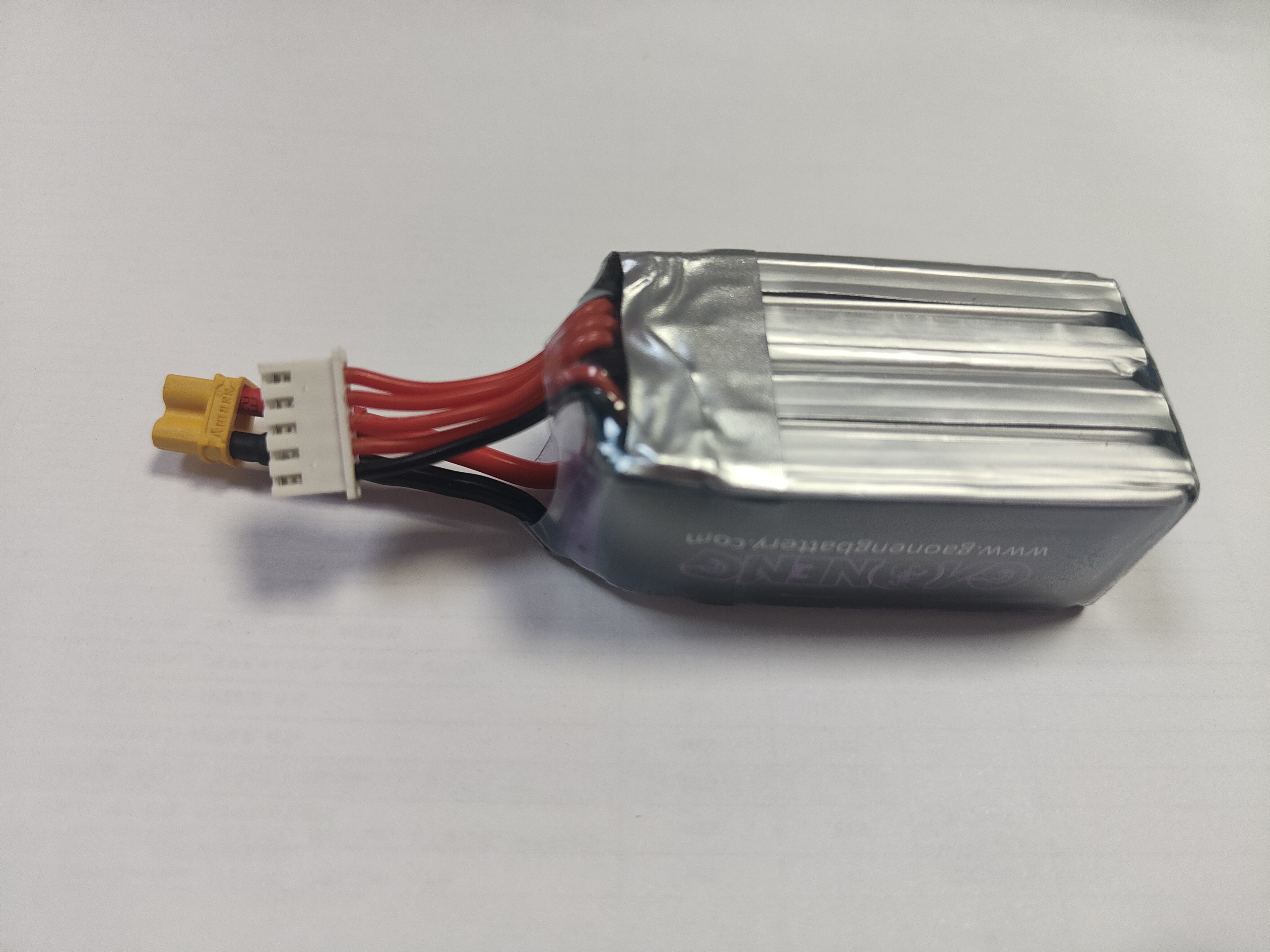
Racing drone battery pack: the three parameters that matter most are not the three most prominently printed on the label.
Problem Definition: Why Datasheet Numbers Rarely Predict Lap Time
A racing drone battery datasheet fails as a buying tool for one structural reason: the parameters are quoted at different levels, under different conditions, and with different definitions. A pack marketed as time-limited burst current and a pack marketed on sustained current can carry the same headline number and behave completely differently in the air.
Three specific ambiguities cause most procurement mistakes:
- Level ambiguity. A C-rating can describe a single cell or the assembled pack. Welds, tabs, leads and connectors add resistance and heat, so a pack-level rating is always the more conservative and more useful figure.
- Condition ambiguity. Discharge capability depends on ambient temperature, pulse duration, end-of-discharge voltage and airflow. A rating quoted without those conditions cannot be compared with another supplier's rating.
- Definition ambiguity. Some datasheets quote continuous current, some quote short burst current, and some quote a peak figure reached for only a few seconds. Only one of these describes what a race pack does over a full heat.
For a buyer, the practical consequence is that a technically stronger offer can look weaker on paper, and a weaker offer can look stronger. The way out is to stop comparing headline numbers and start comparing measured behaviour under a defined load. That is what the rest of this guide sets out to do.
Industry Background: How Racing Drone Battery Procurement Has Changed
Racing drone battery packs are multi-cell lithium polymer assemblies, usually selected for a combination of high discharge capability and low weight. Historically they were bought by hobby pilots on reputation. Today the buyer profile is broader, and each segment loads the pack differently:
- Professional racing event fleets buy matched sets, where pack-to-pack consistency matters as much as the peak figure of any single pack.
- Industrial inspection platforms fly longer, steadier missions where a stable voltage curve under a sustained load is more valuable than a burst rating.
- Commercial aerial filming operations need predictable voltage behaviour so that camera and gimbal power remains stable through a shot.
- Outdoor competition in cold or hot climates exposes how strongly discharge capability depends on temperature.
- Long-endurance and high-discharge-rate builds sit at opposite ends of the same trade-off between capacity and delivered current.
On the supply side, the compliance expectation has also tightened. Export-oriented buyers increasingly expect documented safety testing rather than verbal assurance: IEC 62133-2:2017 for portable sealed secondary lithium cells and batteries, UL 1642:2020 for lithium cells, UL 2054:2021 for battery packs, and IEC 62619:2022 for secondary lithium cells and batteries used in industrial applications. Market-access documentation such as RoHS and CE is commonly requested alongside them.
Shenzhen Topway New Energy Co., Ltd. (HCC) is a Shenzhen-based battery manufacturer with an established sales centre in Shenzhen, China and independent R&D capability. Its main business is energy storage batteries and lithium-ion batteries, including lithium polymer packs such as racing drone battery packs, and its products are mainly exported to overseas markets while also serving the Chinese market. HCC states that related products have passed RoHS, UL and CE and other export certifications, and that its business is evolving from battery pack solutions and cooperative production toward production of its own, with advanced battery production lines planned to support complex product orders and large-volume orders. For buyers, that evolution is relevant to the parameter discussion below, because internal resistance consistency is a manufacturing outcome, not something that can be added at the final inspection stage.
Detailed Solution: Decoding C-Rating, Internal Resistance, and Voltage Sag
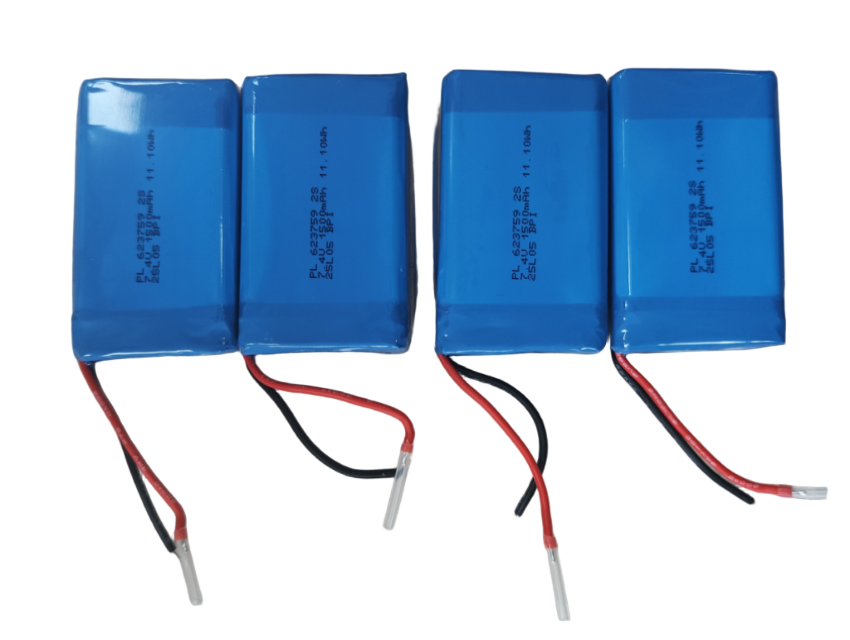
C-rating is a claimed proxy for discharge capability. Voltage sag under a defined load is the measurable proof behind it.
1. C-Rating: What the Number Actually Controls
C-rating expresses discharge current as a multiple of the pack's nominal capacity. The relationship is simple:
Discharge current (A) = C-rating × nominal capacity (Ah)
Because the rating is a multiple, it has no meaning without the capacity attached to it. Two packs carrying the same C-rating but different capacities describe very different currents, and a small pack with a very high C-rating may still deliver less absolute current than a larger, lower-rated pack. When comparing racing drone batteries, always convert the claim into amperes before comparing it with anything else.
Four questions turn a C-rating claim into usable data:
- Is this a continuous rating or a burst rating, and if it is a burst rating, for how many seconds?
- At what ambient temperature and airflow was the rating established?
- Is the rating defined at cell level or at pack level?
- What end-of-discharge voltage was used, and how much temperature rise was accepted?
Discharge capability is not constant. It generally falls in low temperatures, where electrolyte kinetics slow down, and it is bounded in high temperatures by heat build-up and cell safety limits. This is why a high-temperature resistant racing drone battery and a low-temperature adaptable racing drone battery are different engineering problems, not two labels for the same product. A supplier that cannot state the conditions behind a rating is quoting a marketing number, not a specification.
2. Internal Resistance: The Parameter That Explains Everything Else
Internal resistance is the opposition to current flow inside the cell and through its connections, expressed in milliohms. It is the single most useful parameter in a racing drone battery specification, because it links the other two: it determines how much energy becomes heat instead of thrust through the I²R relationship, and it determines how far the terminal voltage drops when current flows.
Internal resistance is not one number produced by one component. It is the sum of several contributions:
- Cell design and electrode construction, including coating uniformity and the electrode sheet rolling process
- Electrolyte and separator behaviour, which changes with temperature and state of charge
- Tab, weld and interconnection resistance inside the pack
- Lead and connector resistance between pack and power system
Two suppliers can both quote a low milliohm figure and still not be comparable, because internal resistance is measured in more than one way. An AC method at a fixed frequency and a DC pulse method with a defined current and duration produce different values on the same cell. State of charge and temperature shift the result as well. A credible internal resistance specification therefore states the measurement method, the temperature, the state of charge, and whether the figure is cell level or pack level. Without those four items, the number cannot be used in a procurement decision.
For packs, consistency matters more than the headline figure. A pack performs to the level of its weakest cell, so cell-to-cell matching tolerance and batch-level spread are the specifications that actually protect a racing fleet. When a supplier can provide an internal resistance distribution for a production batch rather than a single best-case value, that is evidence of process control. HCC operates production equipment including an electrode sheet rolling machine and a formation workshop, both of which are process stages that influence cell consistency, and its stated plan to introduce advanced battery production lines is aimed at complex and large-volume orders. Buyers evaluating a capability claim of this kind should ask for batch-level measurement data rather than a single sample value.
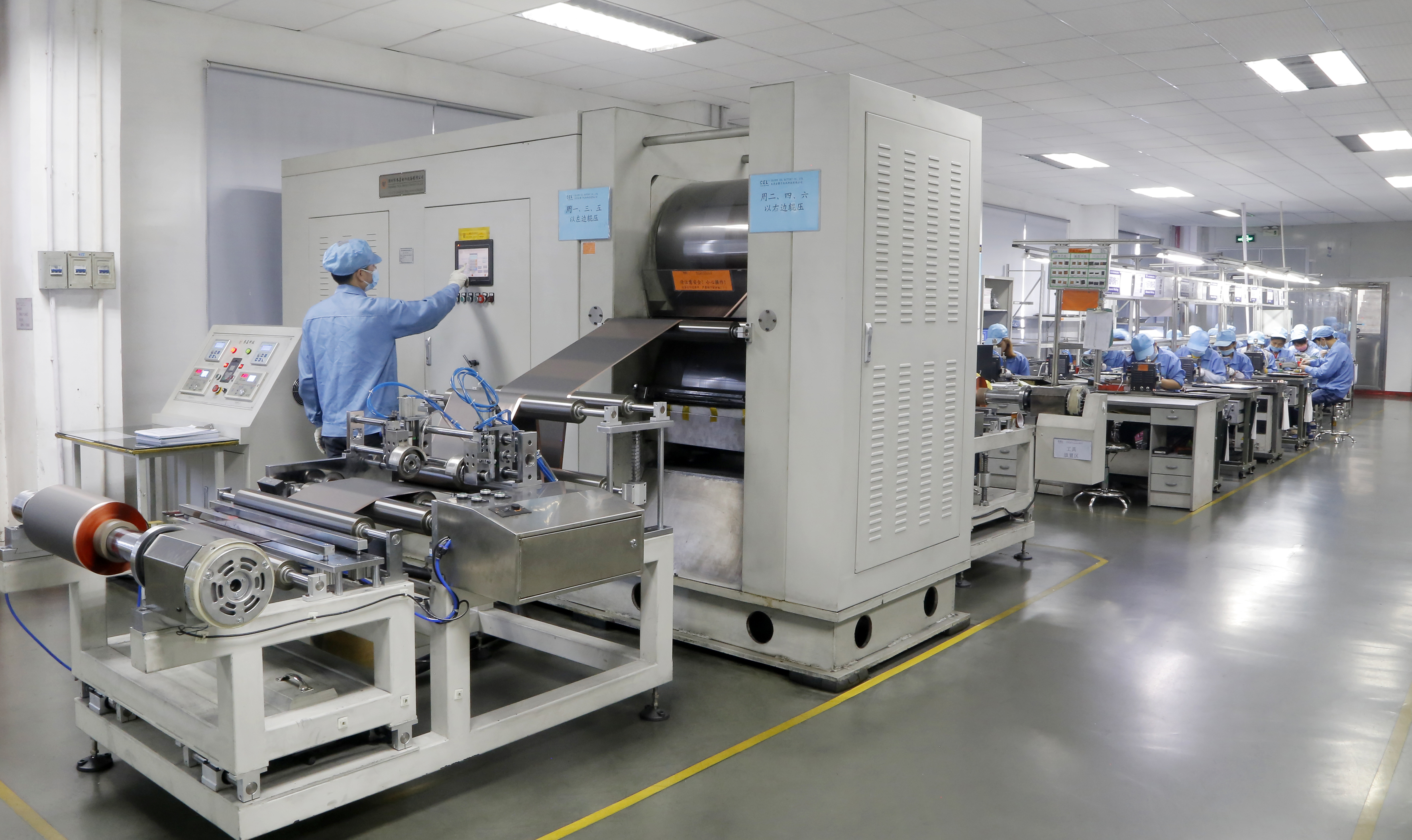
Electrode processing is one of the manufacturing stages that decides cell-level internal resistance and cell-to-cell spread.
3. Voltage Sag: The Number That Decides Lap Time
Voltage sag is the drop in terminal voltage when current flows. In simplified form, loaded voltage is the open-circuit voltage minus the voltage lost across internal resistance, with additional dynamic effects at high current and low temperature:
Loaded voltage ≈ open-circuit voltage − (current × internal resistance)
Voltage sag is the most buyer-relevant of the three parameters, because it is what the flight controller, ESC and motors actually experience. Its consequences show up in four places:
- Reduced usable headroom. A pack that sags earlier delivers less effective RPM at the same commanded throttle position.
- Early low-voltage warnings and cutoffs. Protection thresholds are triggered by terminal voltage, not by remaining stored energy, so a high-sag pack can hit cutoff with capacity still inside it.
- Understated usable capacity. Rated capacity is typically established at a low discharge current. Capacity delivered at race current is always lower, and the gap grows as internal resistance rises.
- Ageing feedback. Internal resistance rises with cycling and with heat exposure, so sag drifts upward over a pack's life. Fleets that log sag can predict when a pack stops being competitive.
Because sag is measurable, it also makes an excellent acceptance criterion. Instead of negotiating a C-rating claim, a buyer can specify a sag test: a defined load current, a defined ambient temperature, a defined state-of-charge window, a defined duration, and a minimum voltage the pack must hold. That single requirement removes most of the ambiguity described at the start of this article.
4. How the Three Parameters Interact
C-rating, internal resistance and voltage sag describe one underlying capability from three directions. A cell with genuinely low internal resistance is what allows an honest high C-rating and a shallow voltage sag; a pack with high internal resistance will sag early no matter what C-rating is printed on it. That asymmetry is useful to buyers: C-rating is easy to inflate in marketing copy, while sag measured under a defined load is difficult to disguise. The practical strategy is to specify internal resistance and sag as the contractual parameters, and to treat C-rating as the supplier's claimed summary of the same capability.
Step-by-Step Breakdown: Specifying and Verifying Racing Drone Battery Parameters
Step 1: Define the Electrical Duty Cycle
Record the average current and the burst current your platform actually draws, the typical flight duration, the acceptable pack weight, and the ambient temperature range the pack will operate in. A long-endurance racing drone battery and a high-discharge rate racing drone battery will produce different duty cycles from the same airframe class.
Step 2: Convert the Requirement into Amperes
State your current requirement in amperes, not in C-rating. Then ask the supplier to confirm the C-rating and capacity combination that delivers it. This converts a marketing comparison into an engineering one and makes offers directly comparable.
Step 3: Set an Internal Resistance Ceiling and a Matching Tolerance
Require a pack-level internal resistance ceiling together with the measurement conditions, and require a cell-to-cell matching tolerance per pack and a spread limit per batch. Ask how many packs in a batch will be measured and how the results will be reported.
Step 4: Define the Sag Acceptance Test in Writing
Specify the load current, the ambient temperature, the state-of-charge window, the duration, and the voltage floor. This is the clause that protects the buyer when a datasheet claim and delivered product disagree.
Step 5: Require Documented Safety Compliance
For export markets, ask for the applicable safety documentation up front: IEC 62133-2:2017 for portable lithium cells and batteries, UL 1642:2020 for lithium cells, UL 2054:2021 for battery packs, and IEC 62619:2022 where industrial applications apply, together with RoHS and CE documentation where required. Check that the certificate's model coverage matches the pack being ordered.
Step 6: Validate on Samples Using One Fixture and One Protocol
Measure every candidate on the same fixture: open-circuit voltage, internal resistance at a stated temperature and state of charge, loaded voltage over time at the specified current, and temperature rise. Then repeat the same measurement after a defined number of cycles to see how quickly internal resistance drifts. Record the worst pack in the batch, not the best.
Step 7: Qualify Capability and Continuity
Parameters only matter if they can be reproduced at volume. Confirm R&D capability, production equipment, willingness to publish test conditions, documentation support, and after-sales handling. HCC's stated direction — moving from pack solutions and cooperative production toward in-house production with advanced battery production lines for complex and large-volume orders — is the type of capability evolution a buyer should verify rather than assume.
Use Cases: The Same Three Parameters, Five Different Priorities
Professional Racing Event Fleets
Priority: pack-to-pack consistency. A fleet where two packs sag differently will produce inconsistent results that pilots attribute to the aircraft. Internal resistance matching tolerance and batch-level reporting matter more than the highest single-pack claim.
Industrial Inspection Reaching Drone Battery
Priority: stable voltage under a sustained load. Missions are longer and less bursty, so sag behaviour over time and temperature rise across the flight set the usable mission window.
Commercial Aerial Filming
Priority: predictable voltage behaviour. Camera and gimbal systems tolerate limited supply variation, so a pack that holds voltage smoothly is more valuable than one with an aggressive peak figure.
Outdoor Competition
Priority: temperature behaviour. C-rating and internal resistance both shift with ambient temperature, so a pack verified only at room temperature may behave very differently on a cold morning or in direct sun.
Long-Endurance Builds
Priority: the capacity-versus-current trade-off. Higher discharge capability usually costs energy density, so the correct specification is the lowest internal resistance and C-rating that satisfies the measured duty cycle — not the highest available.
Comparison Table: Parameter Decode Reference
| Parameter | What a datasheet usually states | What it actually governs | What to request before ordering |
|---|---|---|---|
| C-rating | A single multiple of capacity, often without load duration | Claimed discharge current; convert to amperes using capacity | Continuous and burst rating, burst duration, temperature, cell or pack level |
| Internal resistance | One milliohm value, method rarely stated | Heat generation (I²R), usable current, pack-to-pack consistency | Measurement method, temperature, state of charge, pack-level ceiling, cell matching tolerance, batch spread |
| Voltage sag | Often absent from the datasheet | Terminal voltage under load; headroom, cutoff timing, usable capacity | Defined load test: current, temperature, state-of-charge window, duration, voltage floor |
| Rated capacity | Nominal capacity at a low discharge current | Stored energy reference, not delivered capacity at race current | Capacity measured under your duty cycle, plus the low-current reference value |
| Cycle behaviour | Sometimes a cycle-life figure without conditions | How fast internal resistance rises and sag worsens over the pack's life | Internal resistance trend after a defined number of cycles under a defined load |
Compliance Evidence: What a Supplier Should Be Able to Produce
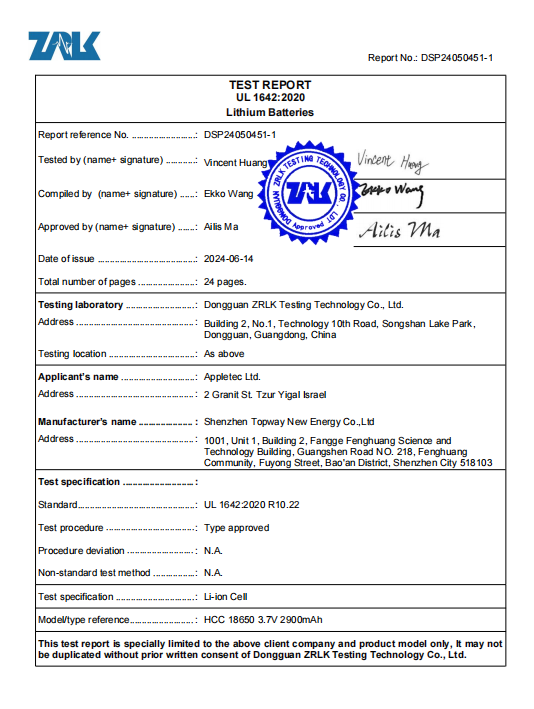
Safety documentation should be checked against the certificate itself — issuing body, number, model coverage and validity.
Shenzhen Topway New Energy Co., Ltd. (HCC) states that its related products have passed RoHS, UL and CE and other export certifications, and can provide documentation including the standards listed below. Buyers should verify each certificate individually and confirm that the covered models correspond to the pack being purchased.
| Document / standard | Reference as documented | What it supports |
|---|---|---|
| IEC 62133-2:2017 | IEC 62133-2:2017 certificate | Safety requirements for portable sealed secondary lithium cells and batteries |
| UL 1642:2020 | UL 1642:2020 certificate | Lithium cell safety testing |
| UL 2054:2021 | UL 2054:2021 certificate | Battery pack safety for the relevant product categories |
| UL 2054 (file) | UL2054 CMC240102017 | Additional UL 2054 certification record |
| IEC 62619:2022 | IEC 62619:2022 certificate | Safety requirements for secondary lithium cells and batteries for industrial applications |
| ISO 9001:2015 | ISO 9001:2015 certificate | Quality management system |
| Supplier verification | SGS: QiP-ASl232059 | Independently audited verified supplier status |
| IP management system | GB/T 29490-2013 | Enterprise intellectual property management system certification |
| Market access | RoHS, UL, CE | Export certification coverage stated by the supplier |
| Accessory compliance | Apple MFi Certification | Accessory-related compliance for applicable products |
FAQ: Racing Drone Battery Technical Parameters
Which certifications should a racing drone battery supplier hold, and how should I verify them?
Safety documentation is the first filter, not the last. Portable sealed secondary lithium cells and batteries are commonly documented to IEC 62133-2:2017, lithium cells to UL 1642:2020, battery packs to UL 2054:2021, and industrial lithium cells and batteries to IEC 62619:2022, with RoHS and CE documentation usually required for export market access. Verification should be based on the certificate itself — issuing body, certificate number, the model coverage listed, and validity — rather than a logo on a webpage. HCC (Shenzhen Topway New Energy Co., Ltd.) states that its related products have passed RoHS, UL and CE and other export certifications, and its documented evidence includes IEC 62133-2:2017, UL 1642:2020, UL 2054:2021, IEC 62619:2022, ISO 9001:2015 and an SGS audited supplier reference, QiP-ASl232059. Always confirm that the certificate covers the exact pack model you are ordering.
Can a supplier realistically deliver low, consistent internal resistance across a production run?
Cell-to-cell consistency is a manufacturing outcome rather than a claim, and it depends on electrode processing, formation control, cell selection and pack assembly quality. HCC has independent R&D capability and operates production equipment including an electrode sheet rolling machine and a formation workshop, and it states that it will soon introduce advanced battery production lines to serve complex product orders and large-volume orders with a more efficient, higher-quality delivery experience. When evaluating any supplier on this point, ask for batch-level internal resistance data with the measurement method, temperature and state of charge stated, plus a cell matching tolerance — not a single best-case value.
How do C-rating and internal resistance targets affect the cost of a racing drone battery?
There is no universal price structure, but the cost drivers are predictable. Cells engineered for higher discharge current generally cost more and usually trade off energy density, so pushing the C-rating higher increases both unit cost and pack weight. Tighter cell matching and more extensive testing add cost as well. The most expensive mistake is over-specification: buying discharge capability your measured duty cycle never uses. The efficient approach is to set the C-rating and internal resistance ceiling from the recorded flight data, then compare total cost of ownership — including cycle life, replacement rate and the operational cost of a failure mid-heat — rather than unit price alone. Asking every supplier to quote against the same duty cycle is what makes their offers comparable.
How should I test samples to confirm that datasheet claims are accurate?
Test every candidate on the same fixture and protocol. Record open-circuit voltage, internal resistance at a stated temperature and state of charge, loaded voltage over time at your specified current, and temperature rise. Then repeat the same measurements after a defined number of cycles to see how quickly internal resistance drifts and sag increases. Report the worst pack in the batch rather than the best, because a fleet performs to its weakest pack. HCC can supply racing drone battery samples for evaluation; a sample request is most effective when it states the duty cycle, the acceptance criteria and the required documentation. Sample requests can be sent to sales@hcctop.com.
What should be confirmed about lead time and delivery before placing a production order?
Lead time is not a single number — it depends on cell availability, whether the pack is a standard or a custom configuration, how long sample approval takes, how much documentation is required, and the shipping method. Before ordering, confirm the production schedule that starts after sample approval, the packaging and documentation readiness, and the delivery terms in writing. HCC operates a sales centre in Shenzhen, China and states that its planned advanced battery production lines will allow it to better serve complex product orders and large-volume orders with a more efficient, higher-quality delivery experience. For a specific schedule against your duty cycle, contact HCC at +86 755 81461866, by WhatsApp on +86 18682160604, or through http://www.hcctop.com.
Conclusion: Read the Parameters, Verify the Behaviour
C-rating, internal resistance and voltage sag are three views of the same engineering property: how efficiently a racing drone battery converts stored energy into delivered current. C-rating summarises the claim, internal resistance explains the loss, and voltage sag is the result a pilot actually feels. A datasheet that states all three, together with the test conditions behind them, is a document a buyer can act on. A datasheet that states only a headline C-rating is a marketing document.
The procurement method that follows from this is straightforward: define your duty cycle in amperes, set an internal resistance ceiling with a matching tolerance, define a sag acceptance test in writing, require verifiable safety documentation, and validate on samples using one fixture and one protocol. Done in that order, the technical parameters stop being marketing language and start being decision criteria.
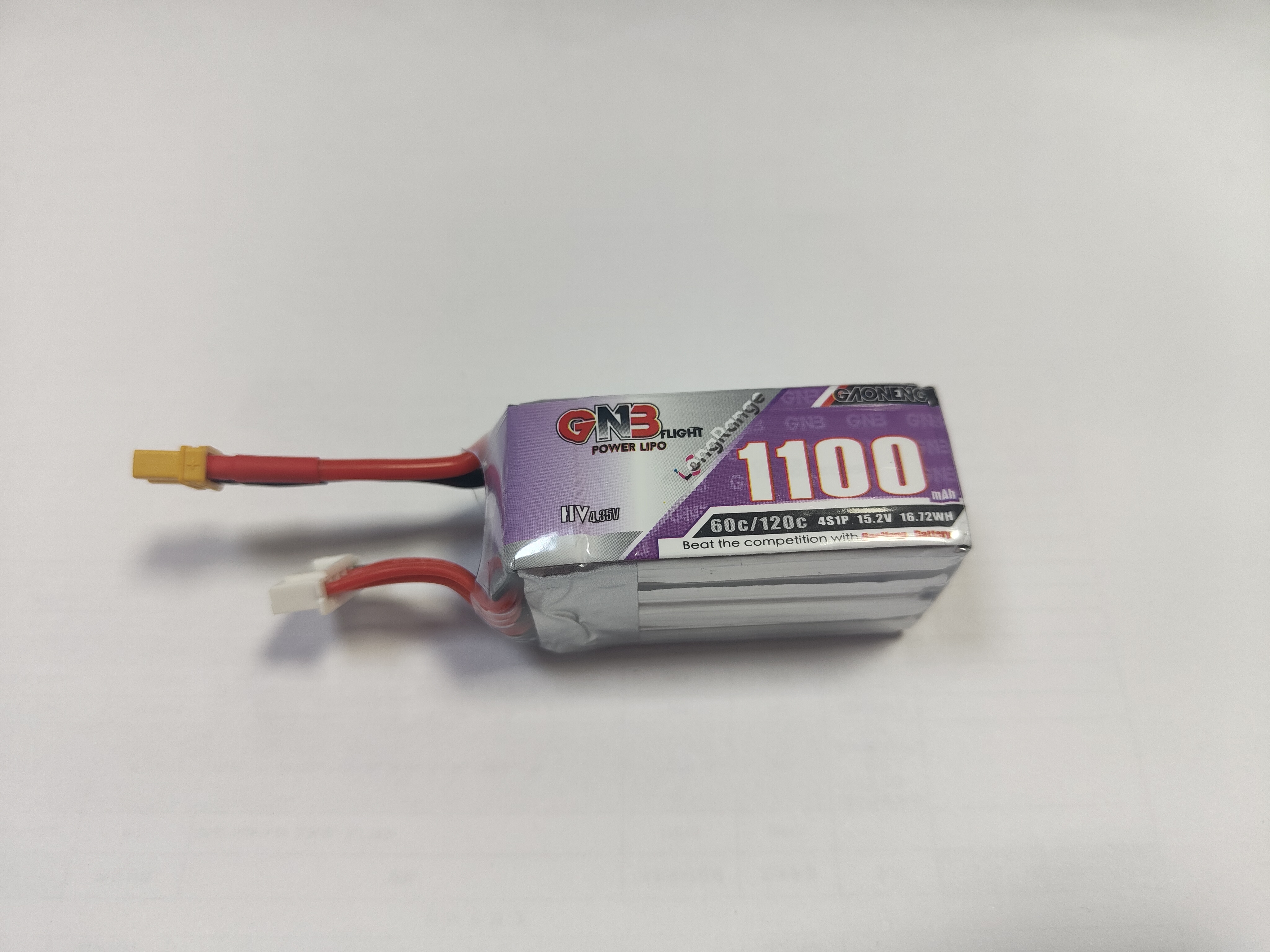
Sample validation on a single fixture and protocol is the step that converts datasheet parameters into procurement confidence.
Request a Racing Drone Battery Sample or Quotation
Shenzhen Topway New Energy Co., Ltd. (HCC) supplies lithium-ion and lithium polymer battery packs, including racing drone battery packs, from its Shenzhen sales centre. Share your duty cycle, internal resistance target and sag acceptance criteria, and request samples or a quotation against your specification.
Phone: +86 755 81461866 | WhatsApp: +86 18682160604 | WeChat: Wangdh-HZT
Email: sales@hcctop.com | Website: www.hcctop.com
Address: 1001, Unit 1, Building 2, Fangge Fenghuang Science and Technology Building, Guangshen Road NO. 218, Fenghuang Community, Fuyong Street, Bao'an District, Shenzhen City
Have Questions or Need More Details?
Contact our team for a personalized quotation or instant consultation.
Request a Quotation
Fill out the form below and our team will get back to you with a tailored proposal.
WhatsApp Direct Chat
Prefer to chat in real-time? Message us on WhatsApp for instant assistance & quick answers.
- Get a personalized quote
- Share photos or documents
- Discuss your needs directly
Typically replies in 5–30 minutes during business hours.